
Hot Cells Facility (OVC)
is intended for the characterisation, sorting and treatment of radioactive materials. It comprises three rooms: the manipulation room (Room A), the central preparatory room (Room B) and the radiological measurements room (Room C). All three rooms are under continuous radiological surveillance, ensuring safe operation and control of possible radiation exposure.
The term “Hot Cells”
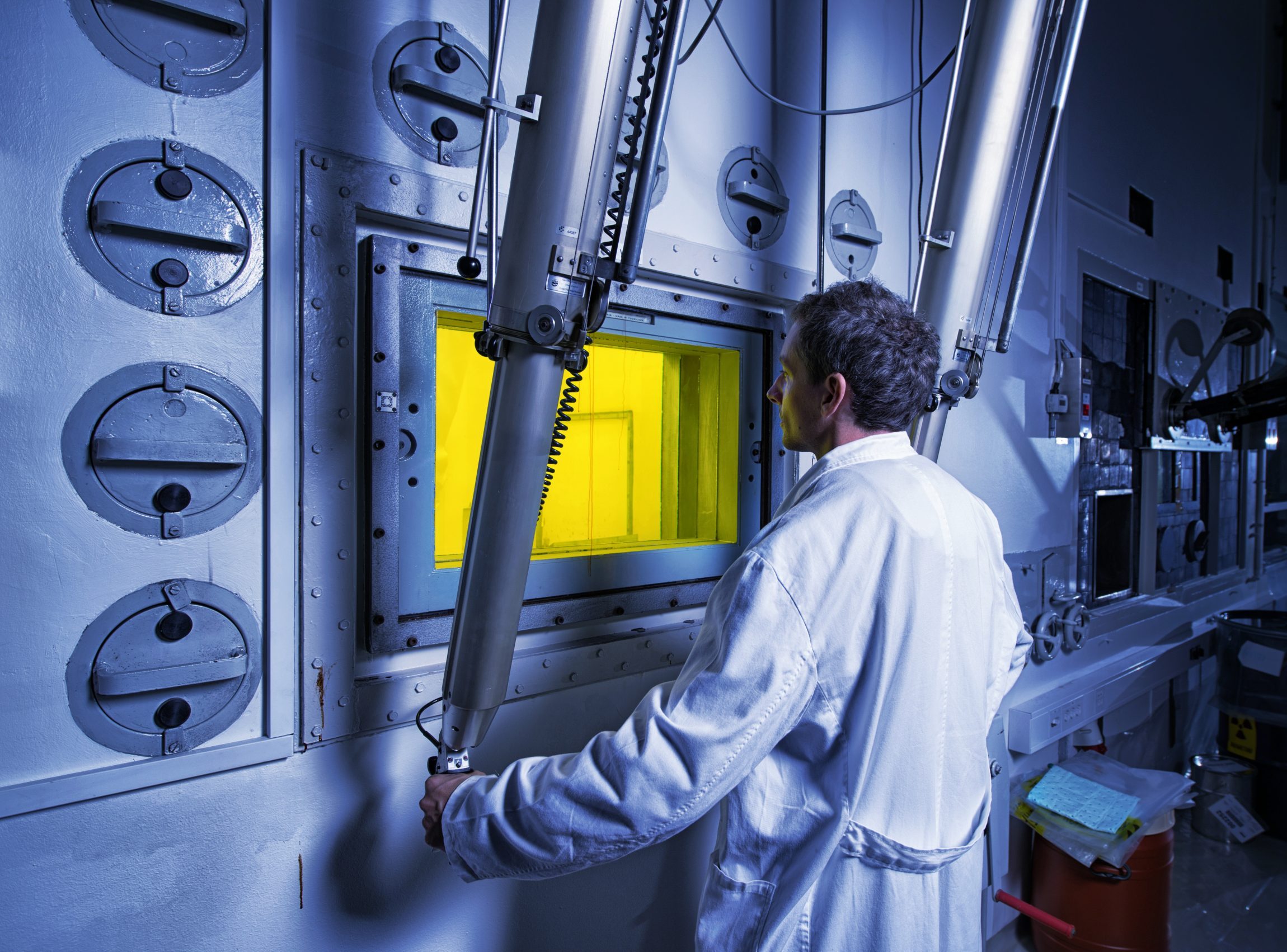
refers to a specially designed shielded room used for handling radioactive materials. The term “hot” does not refer to temperature, but to the presence of ionising radiation. Such rooms are constructed from thick shielding materials (e.g. concrete or lead), which effectively contain radiation and enable safe work with highly active radioactive sources.
Work inside a hot cell
is performed remotely, without direct contact with radioactive materials. Operators use special mechanical manipulators and observe the process through shielded windows or camera systems. This makes it possible to carry out demanding procedures such as opening irradiated samples, sample preparation, processing or storage, while maintaining minimal radiation exposure to personnel. Usage and equipment of hot cells and digesters
It includes three rooms:
- manipulation room (room A),
- central preparatory room (room B) and
- radiological measurements room (room C).
All three facilities are under continuous radiological spatial monitoring, which ensures safe working conditions and supervision of any potential radiation exposure. More information
Hot Cells Facility (OVC)
is intended for the characterisation, sorting and treatment of radioactive materials. It comprises three rooms: the manipulation room (Room A), the central preparatory room (Room B) and the radiological measurements room (Room C). All three rooms are under continuous radiological surveillance, ensuring safe operation and control of possible radiation exposure.
The term “Hot Cells”
refers to a specially designed shielded room used for handling radioactive materials. The term “hot” does not refer to temperature, but to the presence of ionising radiation. Such rooms are constructed from thick shielding materials (e.g. concrete or lead), which effectively contain radiation and enable safe work with highly active radioactive sources.
Work inside a hot cell
is performed remotely, without direct contact with radioactive materials. Operators use special mechanical manipulators and observe the process through shielded windows or camera systems. This makes it possible to carry out demanding procedures such as opening irradiated samples, sample preparation, processing or storage, while maintaining minimal radiation exposure to personnel. Usage and equipment of hot cells and digesters
It includes three rooms:
- manipulation room (room A),
- central preparatory room (room B) and
- radiological measurements room (room C).
All three facilities are under continuous radiological spatial monitoring, which ensures safe working conditions and supervision of any potential radiation exposure. More information
Usage of Hot Cells and Digesters
Hot cells
At the institute, we have two Hot Cells (VC1 and VC2):
VC1
is connected to the TRIGA reactor via a pneumatic system for the transfer of irradiated samples. It is equipped with a device for opening irradiated samples and “master-slave” manipulators for handling radioactive sources. It enables work with radioactive sources of up to 1000 Ci (Co-60).
VC2
is intended for the storage of radioactive sources with activities of up to 1000 Ci (Co-60).
Digesters
A digester is a laboratory device intended for the safe handling of hazardous and health-hazardous substances. In the laboratory, eight digesters are installed: Digesters
D1
and
D2
are equipped with manipulators and intended for work with radiation sources up to 10 Ci (Co-60). Digesters
D3
and
D4
are intended for work with radiation sources up to 0.1 Ci (Co-60). Digesters
D5 – D8
are intended for performing radiological measurements.
Equipment
Equipment available at OVC
- Crane with a load capacity of up to 3.5 tons
- Ultrasonic decontamination bath (bath dimensions: 500 × 400 × 400 mm)
- Hydraulic press for compacting materials into standard 210 L drums
- Mobile working tent made of PVC-film reinforced polyester (4 × 2.5 × 2.5 m)
- Mobile exhaust unit with HEPA filtration
- Electric shears for cutting sheet metal (up to 0.9 mm thickness)
- Electric forklift truck with a load capacity of up to 1.5 tons
- Electronic balance with a load capacity of up to 150 kg
Equipment for Radiological Characterisation
- Alpha spectrometer (with six semiconductor detectors, diameter 2.4 cm)
- Low-level background beta counter (with eight proportional detectors for samples with diameters up to 5.2 cm)
- Gamma spectrometer for object radiological characterisation (40% relative efficiency)
- Total alpha-beta counter for smears and filters (samples with diameters up to 6 cm)
Room A
Manipulation Room
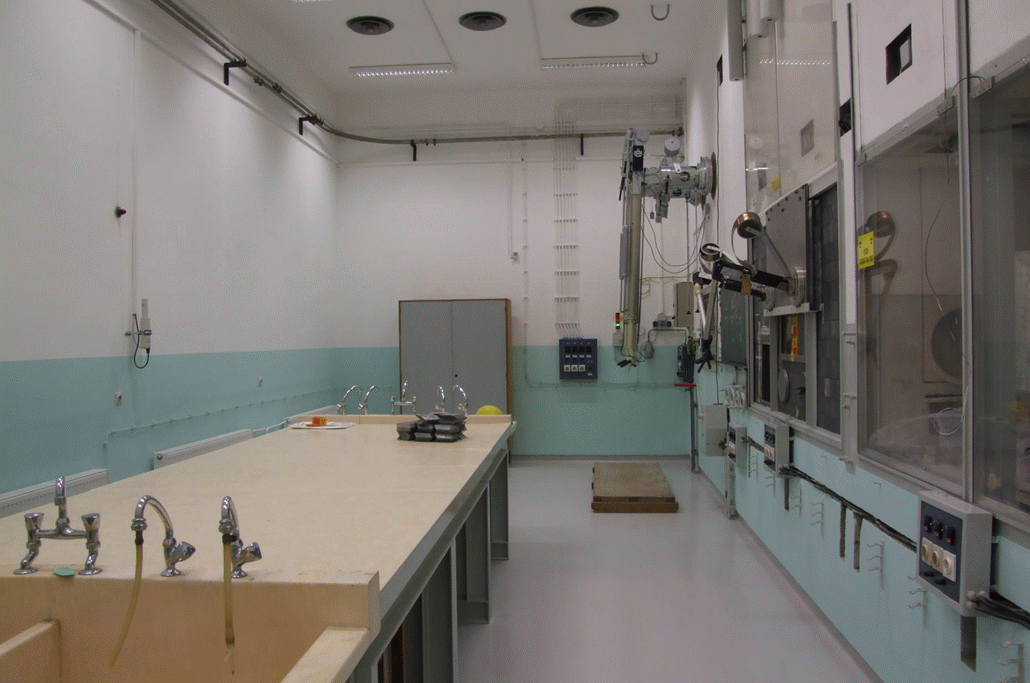
Purpose: access to and work with the hot cells, primarily VC1 and digestors D1–D4.
Room B
Central Preparatory Room
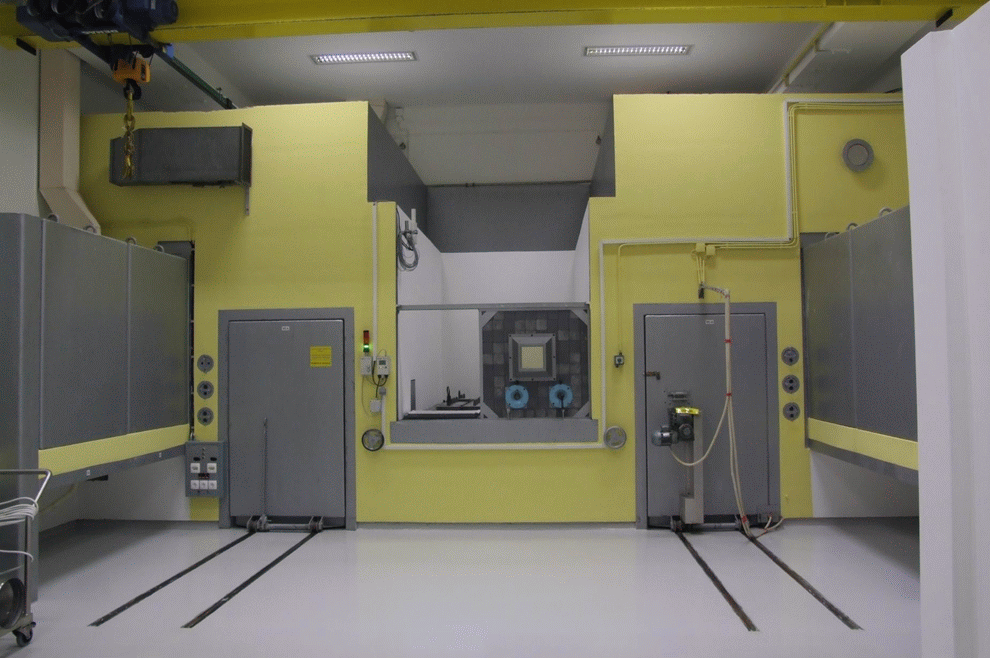
Purpose: preparation and storage of radioactive materials.
Equipment: two hot cells VC1 and VC2; eight digesters D1–D8; depository for solid radioactive materials with 32 positions (Φ 100 mm x 100–250 mm), located between hot cells VC1 and VC2.
Usage: VC1 and D1–D4 are used for handling radioactive sources; access is provided from Manipulation Room A, VC2 serves as storage for radioactive materials, but may also be used for handling radioactive sources with activities of up to 1000 Ci (Co-60) with additional equipment; access is provided from Radiological Measurements Room C.
Room C
Radiological Measurements Room
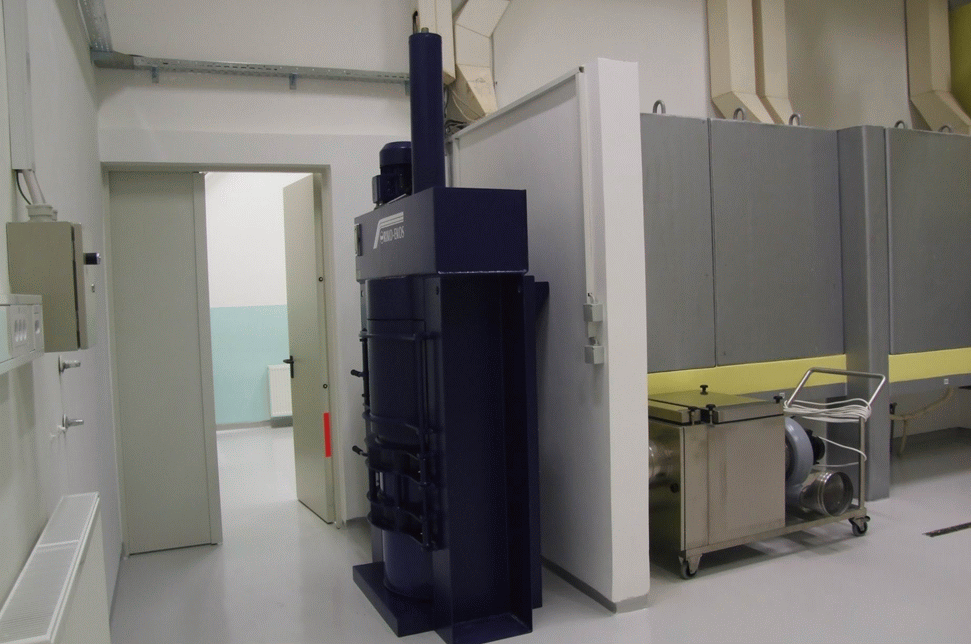
Purpose: carrying out radiological measurements and control of radioactive sources, with access to VC2.
Equipment: four digesters: D5–D8.
Usage: digesters D5–D8 are intended for various radiological measurements.
Room A
Manipulation Room
Purpose: access to and work with the hot cells, primarily VC1 and digestors D1–D4.
Room B
Central Preparatory Room
Purpose: preparation and storage of radioactive materials.
Equipment: two hot cells VC1 and VC2; eight digesters D1–D8; depository for solid radioactive materials with 32 positions (Φ 100 mm x 100–250 mm), located between hot cells VC1 and VC2.
Usage: VC1 and D1–D4 are used for handling radioactive sources; access is provided from Manipulation Room A, VC2 serves as storage for radioactive materials, but may also be used for handling radioactive sources with activities of up to 1000 Ci (Co-60) with additional equipment; access is provided from Radiological Measurements Room C.
Room C
Radiological Measurements Room
Purpose: carrying out radiological measurements and control of radioactive sources, with access to VC2.
Equipment: four digesters: D5–D8.
Usage: digesters D5–D8 are intended for various radiological measurements.